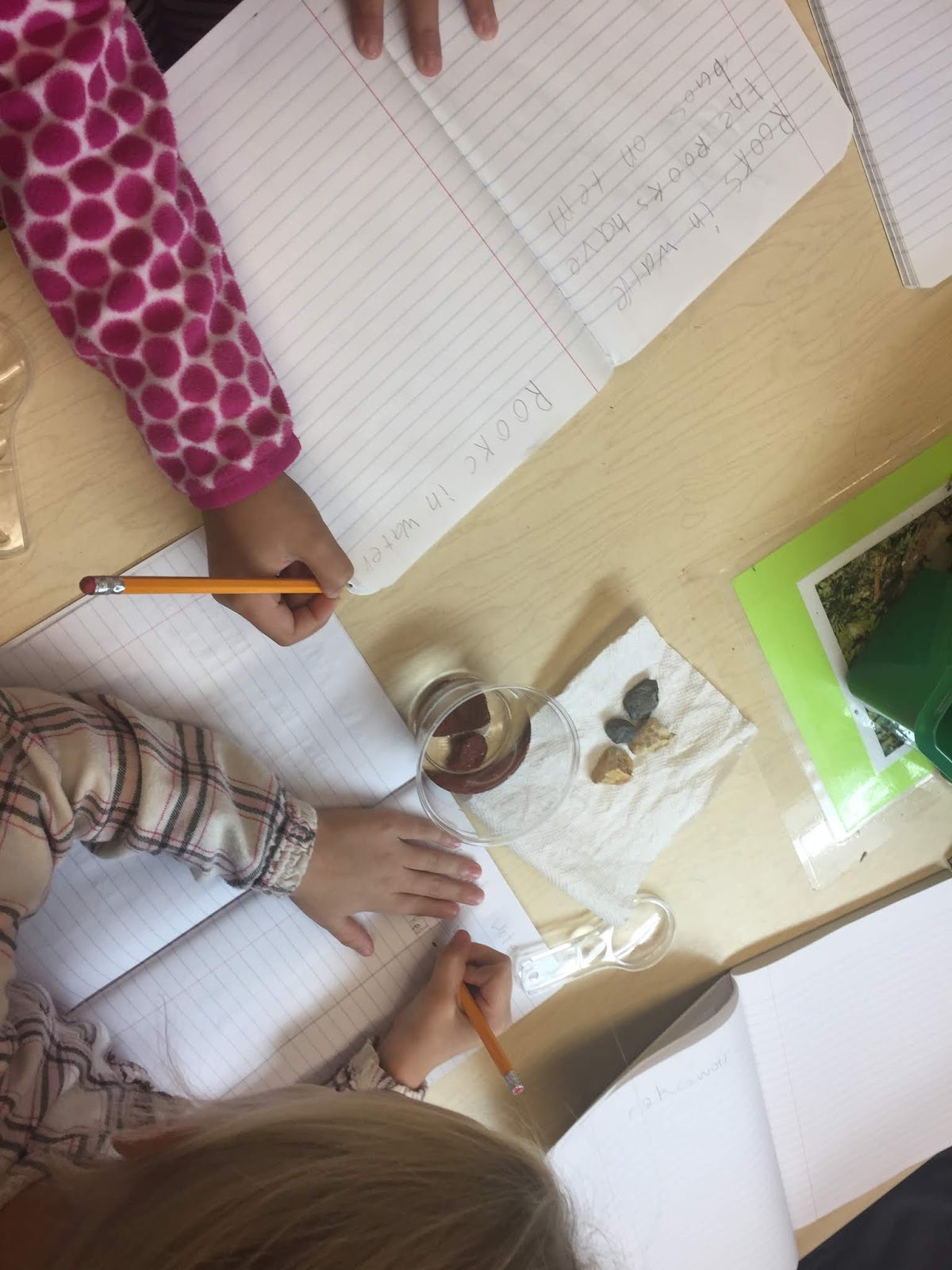
The next investigation had us putting the rocks, one type at a time, into a cup of water. What would happen? The gray basalt rock looked darker. The red scoria had bubbles rise from it and it turned lighter in color. The white tuff turned orange and even purple! There was also a steady stream of very small bubbles coming out of the tuff. We also noticed that the rock dust made the water look "dirty".
Showing posts with label volcanic rock. Show all posts
Thursday, October 17, 2019
2nd Grade Investigates Volcanic Rocks
2nd graders have begun their unit on rocks by observing the properties of three different igneous rocks: basalt, tuff and scoria. They described how the rocks felt, looked and even smelled! Then, we rubbed two of the same rocks together to see what happens. The scoria and tuff both make rock dust while the basalt is such a hard rock that they just make scratch marks.
The next investigation had us putting the rocks, one type at a time, into a cup of water. What would happen? The gray basalt rock looked darker. The red scoria had bubbles rise from it and it turned lighter in color. The white tuff turned orange and even purple! There was also a steady stream of very small bubbles coming out of the tuff. We also noticed that the rock dust made the water look "dirty".
Sunday, October 15, 2017
2nd Grade Investigates Rocks!
How can three volcanic rocks look and feel so different? 2nd grade is investigating and describing three very different types of rocks. They have discovered that properties of rocks (what makes a rock a rock) are a great way to give a detailed description of a specific rock!
| Drawing the rock is one way to show how the rock looks. |
| How does the rock feel? |
| This rock has holes in it. |
| The shape and color are also good ways to describe a rock. |
| The cream rock comes off on your fingers a bit. |
| Is the rock dull or shiny? |
| One of the rocks is smooth. The other two are rough. |
| Everyone is very curious what the rocks are called! |
| What happens when you rub the same rocks together? Some of them make rock dust! |
Thursday, October 20, 2016
2nd Grade Explores Volcanic Rocks
Three very different looking rocks....how can we describe them? How are they the same? How are they different? What happens when we rub the rocks together? 2nd graders are starting to learn about properties of rocks:size, shape, luster, texture, color and even hardness.
| All of the rocks are about the same size. |
| The white rock is smooth. |
| Look at the holes in these rocks! |
| The gray rock is heavier than the other rocks. |
| This rock feels rough and bumpy. |
| I'm making red rock dust! |
| The white rock makes flakes of dust. |
| The gray rocks don't make any dust, but they do make lines on the rock! |
| It's like snow. |
| I can smell the rock when I rub them together! |
Thursday, October 22, 2015
Volcanic Rocks and 2nd Graders!
2nd grade has been looking at three volcanic rocks: basalt, scoria and tuff.

| "Scoria has holes! It looks like a lava rock." |
| "When you rub two of the rocks together they make rock dust!" |
"When the rocks are put in water they change color and the water gets dirty!"
| "There are bubbles coming from the rocks!" |
Subscribe to:
Comments (Atom)